(Em)Powering Smart Cities
Designing for Resiliency in the Leapfrog Age
ICMAC 2017, Denpasar, Bali
i'm dietrich ayala, and i work for the internet.
      * most know us by firefox
      * but firefox is a tool we use to guide the direction of web tech
      * why does mozilla want to talk about smart cities at an event like this?
      * care and feeding tech for healthy and successful innovation for people
      * you're making decisions now about privacy, security and what technologies to use
      * and we want to see you succeed
      * we want to see your innovations work for *everyone*
"Within bitsphere communities, there will be subnetworks at a smaller scale still – that of architecture. Increasingly, computers will meld seamlessly into the fabric of buildings and buildings themselves will become computers – the outcome of a long evolution."
William J. Mitchell,
City of Bits (1995).
      * interestingly, the network turned out to be *people*
      * buildings as computers is really only starting
      * and i don't think we're ready yet
      * people engaging in community through for-profit verticalized apps
      * standards for privacy and security at substructure layer are not mature
      * which means the market is flowing with technology and products untrusted by consumers
      * additionally, the tech we're building now will be obsolete in a few years
      * how to build for a moving target? huge investments into massive projects with predictable obsolescence
      * the stack today looks like this
      * some of these are proprietary silos
      * some are aging infrastructure
      * some have no security or privacy standards
      * hackers are using this one to run botnets
      * what do thomas jefferson, leon trotsky and buddha have in common?
      * tj said each generation should have a revolution
      * trotsky thought permanent revolution was key to true communism
      * the buddha teaches us impermanency in every moment
      * they all designed for constant change
      * designing for permanent state of leapfrogginess
      * probably not possible, or even desirable
      * but i'm going to talk about some patterns for designing technology that can do that
      * specifically i'm going to talk about how to engage and empower users in relevant ways in public spaces
      * example of advanced smart cities program
      *
* right now room scale computing looks like this
Open or Install?
URL or App?
      - easier to get someone to open a URL than to install an app
      - instant content vs multiple steps
      - ux and ix make the difference in access to information and services
      * bluetooth
      * good for multi-floor spaces
      * configurable radio signal for distance
      * google backported nearby to Android Kit Kat, 4.4
      * get notification as users experience a space
      * potential for notification storm, abuse
SPEECH
NOISE!
      * a lot of talk about speech recognition
      * but differences in the ambient decibel level are a signal
      * you don't need fancy speech recognition to know if someone walked in the room
      * or if someone is asleep vs awake
      * but how do you know if there's a computer in the room?
      * how do you know if something is listening?
      * noise can be a signaller for presence/absence and whether to send notification, have the robot say "hi", etc
      * proximity
      * also explored privacy concerns
      * signaling in public spaces
* but what to do once you've got people connected?
PATTERNS
& FLOW
      * onboarding technology has led to new software inputs
      * and requires new patterns and task flows in our designs
➡️ 
➡️ URL
➡️ app
      * now we've got an interaction flow going
      * and with PWA we have things like push notifications
      * so we can re-engage during app switching or whatever as someone moves through a space
      * complex topology in our interactions
      * bluetooth mesh spec is coming soon
➡️
➡️ URL
➡️ 
➡️
➡️ URL
➡️ 
➡️
➡️ URL
➡️ Payment API
➡️ 💰💰💰
PaymentRequest Example
var request = new PaymentRequest(
  supportedPaymentMethods,
  paymentDetails,
  options
);

request.show();
➡️
➡️ URL
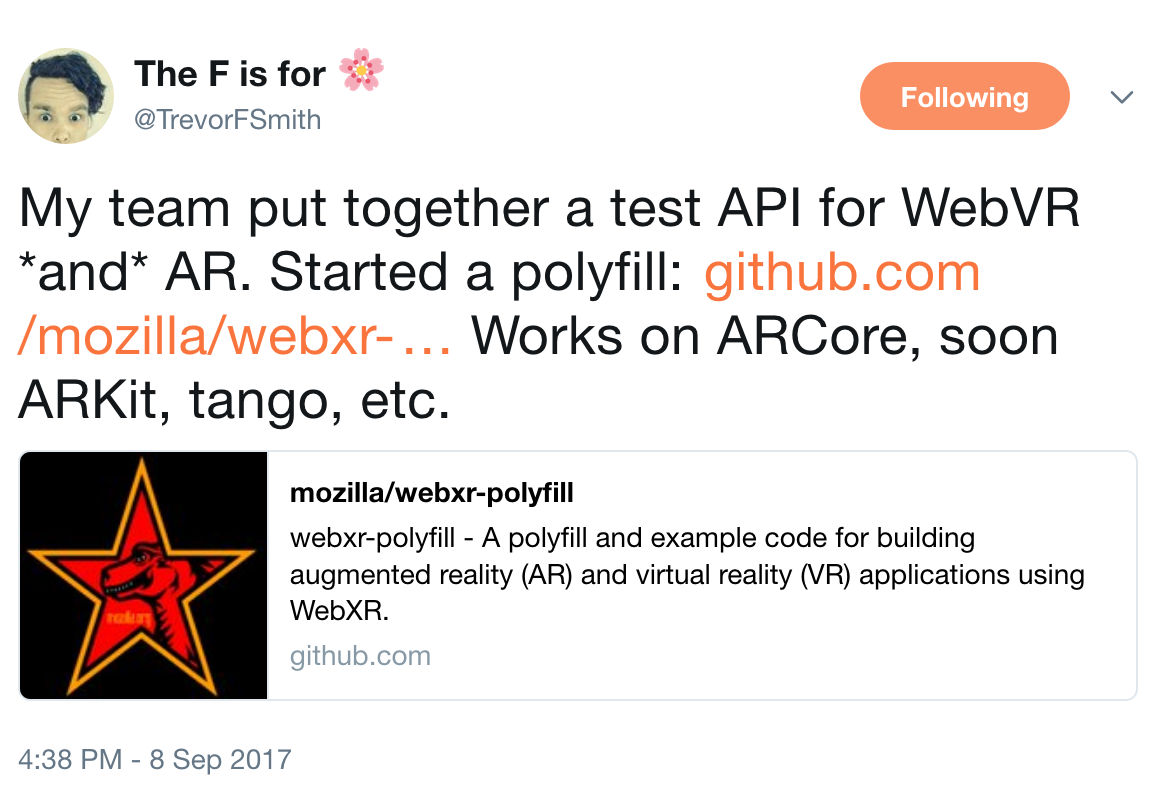
➡️ AR / VR

Web Manifest
ServiceWorkers
Push Notifications
getUserMedia()
        navigator.mediaDevices.getUserMedia({
           audio: true,
           video: true
        }).then(function (stream) {
          // do something with the stream
        })
A-Frame Example
        <a-scene>
          <a-sphere radius="1.25"></a-sphere>
          <a-box width="1" height="1" depth="1"></a-box>
          <a-cylinder radius="0.5" height="1.5"></a-cylinder>
          <a-plane rotation="-90 0 0" width="4" height="4"></a-plane>
        </a-scene>
INVISIBLE
COMPUTING
      * too many apps
      * not enough choice
      * but we're moving into an era of invisible computing
      * right now the apps are at least visible
      * is this the roomscale endgame?
      * it's not the future we want
* but what's really going on is this.
    * this is the new web
    * integrated multisensory physical+digital experiences
    * bridging platforms
    * frictionless physical interaction flows
    * ubiquitous physical computing
    * mobile
    *
    * the hardware isn't here yet. but it's not far off.
    * native and proprietary tech is here to stay in some form.
    * the web is ready to glue these things together
    * to make really interesting things
    * and these are things you can do *now*
    *
    * we need a responsive design for physical spaces
    * we need a design language for physical interactions
    * if we wait, amazon, google, apple will design this language for us
    * using hardware to define the spaces we can design for
    * but with the open web we have an opportunity now
    * to get ready for these quickly coming technologies
    * and fight the hegemony of the few big hardware providers
    * and define the interactions we want to see.
      * they all designed for constant change
      * flexible and resilient infrastructure in our technologies
      * not only resilient to change, but inviting and encouraging of it.
      * so that we can quickly adapt to what an immediately-different future brings

Dietrich Ayala
@dietrich